

BEST ROULETTE WINNING SYSTEMS

ROULETTE MATHEMATICAL SYSTEM
What Is a Roulette Mathematical System?
When people search for a roulette mathematical system, they often hope to discover a secret formula capable of predicting winning numbers or guaranteeing consistent profits. In reality, a mathematical system is something entirely different.
A roulette mathematical system is a structured set of rules that determines how bets are placed and managed during a gaming session. Its purpose may be to recover previous losses, maximize winning streaks, or control the player's bankroll more effectively. However, it is essential to understand one fundamental principle: no mathematical system can change the actual odds of the roulette wheel.
Every system focuses exclusively on how much to bet and when to increase or decrease the stake. It does not influence where the ball will land.
What Does a Mathematical System Actually Do?
Every roulette system has been designed with a specific objective. Some systems attempt to recover losses by progressively increasing the bet after each losing spin. Others aim to protect profits by reducing the stake after a win, while certain methods are primarily intended to improve bankroll management and maintain a disciplined betting approach over longer sessions.
Although these systems differ considerably, they all share one important characteristic: They only control the betting strategy—they do not affect the outcome of the game.
Whether a player follows the Martingale, Fibonacci, D'Alembert, or any other betting progression, the probability of winning an individual bet remains exactly the same.
Mathematical System, Betting Progression and Strategy: Understanding the Difference
Many players use the terms system, strategy and progression interchangeably, but they actually describe different concepts. A mathematical system is the complete framework that governs how the player manages bets throughout a session.
A betting progression refers only to how the wager changes after each win or loss. The Martingale, Fibonacci and D'Alembert are classic examples of betting progressions.
A roulette strategy, on the other hand, is a broader concept. It may include bankroll management, table selection, betting limits, stop-loss rules, profit targets and even the duration of each playing session.
Understanding these distinctions makes it much easier to evaluate any roulette system objectively.
Why Are They Called "Mathematical" Systems?
Roulette systems are described as mathematical because they rely on precise numerical rules.
For example, a system may require the player to:
- Double the stake after every loss.
- Follow the Fibonacci sequence.
- Increase the wager by one betting unit.
- Reduce the stake after each win.
- Apply a predetermined numerical pattern.
All of these methods are based on mathematical calculations and numerical sequences. However, the mathematics applies only to money management—not to predicting future outcomes.
Can a Mathematical System Beat Roulette?
This is undoubtedly the most frequently asked question among roulette enthusiasts.
From a mathematical perspective, the answer is straightforward:
No betting system can eliminate the casino's built-in house edge on a fair roulette wheel.
Each spin is an independent event. The fact that black has appeared five consecutive times does not increase or decrease the probability of red appearing on the next spin.
Likewise, increasing or decreasing the size of your wager has absolutely no effect on the wheel itself. This does not mean betting systems are completely useless. Many players find them valuable because they provide structure, encourage discipline, and help avoid emotional decision-making during winning or losing streaks.
Why Are Roulette Systems Still So Popular?
Despite their mathematical limitations, roulette systems continue to attract millions of players around the world.
The reason is simple. Following a structured set of rules creates a sense of control and removes much of the guesswork involved in deciding how much to bet. Furthermore, some systems can produce impressive short-term winning streaks, leading many players to believe they have discovered a profitable approach. Over the long run, however, probability tells a different story. The casino's mathematical advantage remains constant regardless of the betting system being used.
Our Editorial Approach
Throughout this guide, you won't find exaggerated claims or promises of "guaranteed winning systems." Instead, our editorial team has carefully analysed the most popular roulette mathematical systems using statistical simulations, practical examples and mathematical calculations. Each system will be evaluated objectively, highlighting its strengths, weaknesses, level of risk and long-term behaviour.
Our goal is not to convince you that one system is superior to another, but to provide the knowledge you need to understand how roulette mathematical systems really work and what realistic expectations every player should have.

BONUS
€500 + 200 free spins

T&Cs apply
No UK Players - 18+ Play safe

BONUS
€100 + 300 free spins
T&Cs apply
No UK Players - 18+ Play safe

BONUS
Up to $1.500
(Subject to change and country-specific)
18+ Play safe
How Roulette Works Mathematically
Before analysing any roulette mathematical system, it is essential to understand the mathematics behind the game itself. Many players spend countless hours searching for the "best" betting system without first learning how roulette probabilities actually work. The reality is simple: every betting system is ultimately governed by the laws of probability. No progression, no staking plan and no mathematical formula can alter the fundamental mathematics of the roulette wheel.
For this reason, understanding probability, expected value and the house edge is far more important than memorising dozens of betting systems.
Roulette Is a Game of Probability
Every spin of the roulette wheel is an independent event. This means that the outcome of one spin has absolutely no influence on the next. For example, if the ball lands on black six consecutive times, the probability of red appearing on the following spin remains exactly the same as it was before. The wheel has no memory.
This concept is one of the most important principles of probability theory and explains why many popular betting beliefs are mathematically incorrect.
One of the most common mistakes made by players is believing that a colour, number or betting option is "due" simply because it has not appeared for a long time. This misconception is known as the Gambler's Fallacy, and it has caused countless players to make irrational betting decisions.
European Roulette vs American Roulette
From a mathematical perspective, not all roulette wheels are created equal.
European Roulette contains 37 pockets, numbered from 0 to 36.
- 18 Red numbers
- 18 Black numbers
- 1 Green Zero
American Roulette contains 38 pockets, because it includes both a single zero (0) and a double zero (00).
Although this may seem like a small difference, it almost doubles the casino's mathematical advantage.
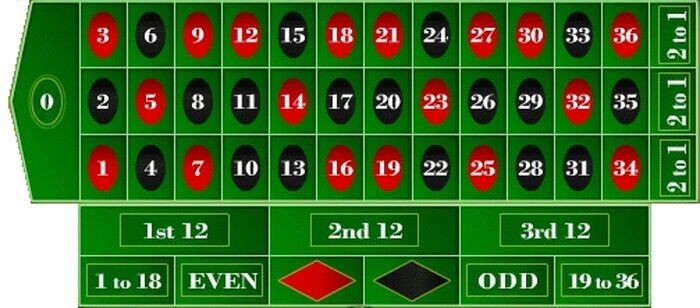
European Roulette
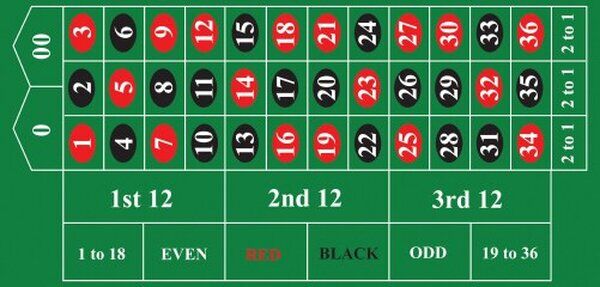
American Roulette
For this reason, virtually every professional roulette analyst recommends playing European Roulette whenever possible.

Understanding Roulette Probabilities
Every possible roulette bet has a precise mathematical probability of winning. Take the simplest example: betting on a single number in European Roulette.
There is only one winning pocket out of 37 possible outcomes.
Therefore: Probability = 1 ÷ 37 = 2.70%
This means that, on average, one specific number will appear once every 37 spins. However, randomness means it could appear twice within five spins—or fail to appear for over one hundred spins.
Probability describes what happens over the long term, not what must happen during a short playing session.
The same principle applies to every other roulette bet.
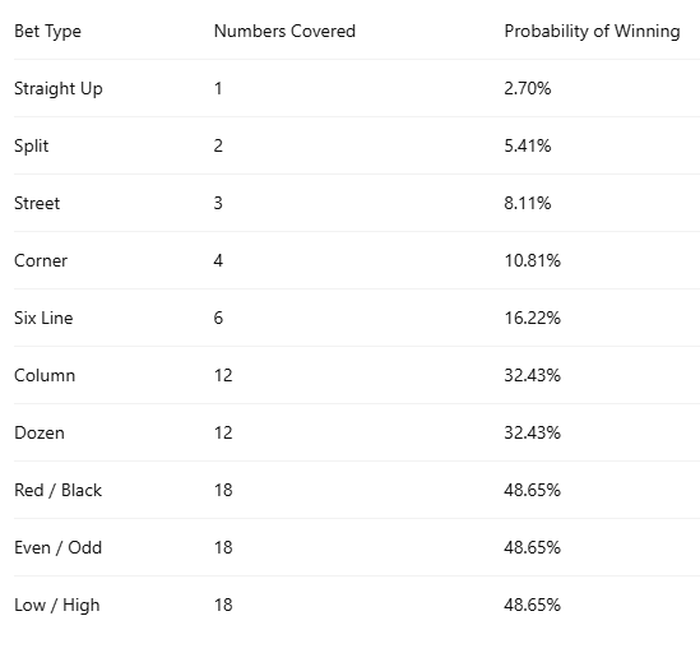
As more numbers are covered, the probability of winning increases, but the payout decreases accordingly. This balance ensures that every standard roulette bet carries exactly the same mathematical expectation.
Why the Casino Always Has the Advantage
The answer lies in a single green pocket.
If roulette consisted of only 36 red and black numbers, an even-money bet would have a true 50% chance of winning.
The addition of the green zero changes everything.
Instead of winning 18 times out of 36 spins, a player now wins only 18 times out of 37.
That seemingly insignificant difference creates the casino's house edge.
This mathematical advantage is built directly into the game and applies equally to every player, regardless of experience or betting strategy.
Over thousands of spins, this small percentage becomes remarkably consistent.
Expected Value Explained
One of the most important concepts in gambling mathematics is Expected Value (EV).
Expected Value represents the average amount a player can expect to win or lose over a very large number of identical bets. In European Roulette, every standard bet has a negative expected value because of the house edge.
This means that, statistically speaking, a player wagering £100 over the long run should expect an average theoretical loss of approximately £2.70, while the casino retains that amount as its mathematical advantage. Of course, individual sessions rarely produce exactly this result. A player may enjoy substantial short-term profits or experience significant losses.
However, as the number of spins increases, actual results tend to move closer and closer to the theoretical expectation predicted by probability.
Why Betting Systems Cannot Change the Odds
This is perhaps the single most important concept to understand.
Whether you follow the Martingale, Fibonacci, Labouchère, D'Alembert or any other betting progression, the probability of each spin remains unchanged.
Changing the size of your wager does not alter the behaviour of the roulette wheel. The wheel has no knowledge of previous bets, previous wins or previous losses.
Every new spin begins with exactly the same probabilities as the one before it.
Betting systems simply redistribute the amount of money risked during a playing session—they do not change the mathematical expectation of the game.
Variance and Short-Term Results
If roulette has a negative expected value, why do some players enjoy long winning streaks? The answer is variance.
Variance describes the natural fluctuations that occur in any game of chance. In the short term, almost anything can happen. A player may double their bankroll within an hour. Another may experience ten consecutive losing bets. Both outcomes are perfectly consistent with probability. Variance explains why betting systems sometimes appear successful over short sessions, even though their long-term mathematical expectation remains negative.
The Law of Large Numbers
One of the most important principles in statistics is the Law of Large Numbers.
This law states that as the number of trials increases, actual results tend to move closer to the theoretical probabilities. For roulette, this means that the casino's mathematical advantage becomes increasingly apparent over thousands—or even millions—of spins.
While short-term fluctuations are inevitable, long-term outcomes gradually converge towards the expected mathematical values.
This is precisely why casinos can confidently operate roulette tables every day around the world.
Mathematics Improves Understanding—Not Prediction
Learning the mathematics behind roulette does not remove the excitement of the game.
Instead, it allows players to approach every betting session with realistic expectations and a much deeper understanding of how the game actually works. A mathematical system can help organise betting decisions, improve bankroll discipline and reduce emotional gambling. What it cannot do is overcome the fundamental laws of probability.
Below, we list the world's most popular roulette mathematical systems one by one, analysing how they work, where they perform well, where they fail, and what the mathematics really tells us about their long-term effectiveness.

- ROULETTE SYSTEM 1 - MARTINGALE
- ROULETTE SYSTEM 2 - MARTINPLUS
- ROULETTE SYSTEM 3 - D'ALEMBERT
- ROULETTE SYSTEM 4 - FIBONACCI
- ROULETTE SYSTEM 5 - PAROLI
- ROULETTE SYSTEM 6 - LABOUCHERE
- ROULETTE SYSTEM 7 - PIVOT
- ROULETTE SYSTEM 8 - LUCKY 13
- ROULETTE SYSTEM 9 - RED AND BLACK
- ROULETTE SYSTEM 10 - VAN DORN
DISCLAIMER:
The publisher assumes no responsibility for any use other than educational, regarding the application of the system contained in this site, and does not in any way want to promote gambling addiction. We do not promise and DO NOT guarantee winnings to anyone and therefore no financial guarantees are given. If you decide to apply the information to play for real money, you remain solely responsible for the performance of your account, and by reading what is published here implies acceptance of these terms.